🔍 Introduction
In most coir factories, when a machine stops or production drops, the first assumption is mechanical failure.
However, the reality is different.
👉 A large percentage of operational issues originate from electrical and control system inefficiencies, not the machinery itself.
Across pith processing, fiber extraction, and baling operations, these hidden issues silently:
- ⚡ Increase energy consumption
- 🛠️ Reduce equipment lifespan
- ⛔ Cause unplanned downtime
The biggest challenge?
These problems remain unnoticed until they turn into costly failures.
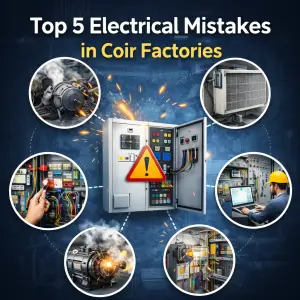
Let’s examine the top 5 electrical mistakes commonly found in coir factories—and their real impact.
⚡ 1. Absence of Dry-Run Protection
Many coir units operate pumps and motors without adequate dry-run protection.
🚨 What happens:
- Equipment runs without material/load
- Motors overheat due to improper operating conditions
- Internal wear accelerates
📉 Impact:
- Frequent motor failures
- Increased maintenance costs
- Unexpected production interruptions
👉 A well-designed protection logic within the control panel can eliminate this risk.
🌡️ 2. Inadequate Panel Ventilation
Control panels are often exposed to high temperatures and dusty environments without proper cooling systems.
🚨 What happens:
- Heat accumulation inside the panel
- Component stress and premature failure
- Reduced operational efficiency
📉 Impact:
- Failure of contactors and relays
- PLC/HMI instability
- Reduced panel lifespan
👉 Proper ventilation, cooling fans, and thermal design are essential for reliability.
🔘 3. Over-Reliance on Manual Switching
Manual operation is still common in many coir factories, relying heavily on operator judgment.
🚨 What happens:
- Inconsistent machine operation
- Increased human error
- Improper sequencing of processes
📉 Impact:
- Variations in production output
- Higher labour dependency
- Increased risk of equipment damage
👉 Automation ensures consistent, precise, and repeatable operations.
⚡ 4. Lack of Overload & Voltage Protection
Electrical fluctuations are inevitable—but many systems lack adequate safeguards.
🚨 What happens:
- Motors operate under unsafe voltage conditions
- Overloading remains undetected
- Gradual equipment degradation
📉 Impact:
- Frequent motor rewinding
- Sudden equipment breakdowns
- Reduced operational lifespan
👉 Integrated protection systems are critical for safeguarding plant assets.
🔄 5. Absence of Intelligent Control (Automation)
Many coir plants still operate using conventional panels without advanced control logic.
🚨 What happens:
- Machines run continuously without demand
- No real-time monitoring or feedback
- Lack of fault diagnostics
📉 Impact:
- Elevated electricity costs
- Unplanned downtime
- Limited operational visibility
👉 PLC-based automation transforms conventional setups into efficient, intelligent systems.
✅ Conclusion
In most cases, coir factories are not limited by machinery—but by control system design and electrical efficiency.
The difference between a plant that struggles with:
- ⛔ Frequent breakdowns
- 📉 High operational costs
And one that achieves:
- ⚙️ Stable performance
- 📈 Higher productivity
👉 Lies in the strength of its electrical and automation systems.
By addressing these critical mistakes, you can:
✔ Reduce downtime
✔ Extend equipment life
✔ Optimize energy consumption
✔ Improve production consistency
💡 Final Insight
Your plant’s performance is defined by the intelligence of its control system.
If your operations still rely on manual processes and basic panels…
👉 You’re not just operating inefficiently—you’re losing value every day.