
In the world of industrial automation—especially within Sewage Treatment Plants (STP) and motor control centers—selecting the right communication protocol for your flowmeter isn’t just a technicality; it’s a decision that impacts your system’s reliability, cost, and data depth.
When you’re staring at a spec sheet, the choice usually boils down to two heavyweights: the time-tested 4–20 mA analog signal and the data-rich RS485 digital protocol. Both have earned their place on the factory floor, but which one belongs in your panel?
The Contenders: Analog Simplicity vs. Digital Intelligence
To make the best choice, we need to look at how these two signals perform under real-world pressure.
1. Signal Type & Data Capability
The fundamental difference lies in what is being sent across the wire.
-
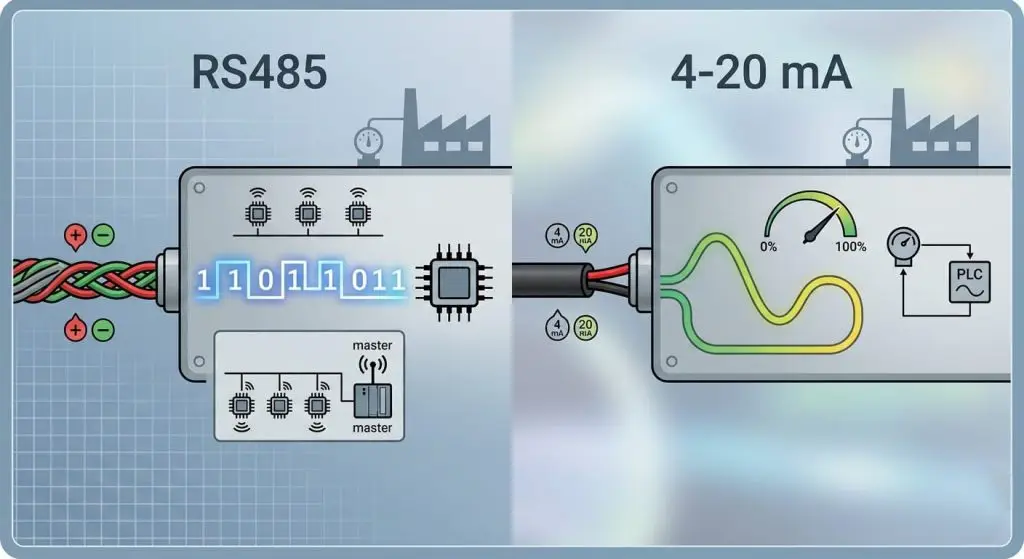
4–20 mA (The Specialist): This is a linear analog current signal. It represents a single value—usually the flow rate—where $4text{ mA}$ equals zero and $20text{ mA}$ represents the full scale. It does one job, and it does it well.
-
RS485 (The Generalist): Using digital communication (typically Modbus RTU), RS485 sends actual data packets. It doesn’t just tell you the flow rate; it can simultaneously transmit the totalizer value, fluid temperature, and device diagnostics.
2. Distance and Noise Immunity
In industrial environments filled with VFDs and large motors, “noise” is the enemy.
-
4–20 mA: This is the gold standard for noise immunity. Because it is a current loop, it is largely unaffected by voltage drops or electromagnetic interference, making it incredibly reliable for distances up to 1–2 km.
-
RS485: While also capable of long distances (up to 1200 m), it is more sensitive to poor grounding and shielding. It requires high-quality twisted-pair cabling and proper termination resistors to function correctly in high-noise areas.
3. Wiring, Integration, and Cost
-
The Analog Path: 4–20 mA is simple. It’s a 2-wire connection that plugs directly into a PLC analog input. There’s no programming or “handshaking” required, leading to lower setup costs and zero engineering headaches.
-
The Digital Path: RS485 allows for daisy-chaining, meaning you can link multiple flowmeters on a single pair of wires. However, it requires more “upfront” engineering—you must configure baud rates, parity, and device addresses in your SCADA or PLC system.
Comparison at a Glance
| Feature | 4–20 mA (Analog) | RS485 (Digital/Modbus) |
| Data | Single Value (Flow Rate) | Multiple (Flow, Total, Temp, Faults) |
| Noise Immunity | Exceptional (Best for VFD panels) | Good (Requires proper shielding) |
| Complexity | Low (Plug & Play) | Moderate (Requires configuration) |
| Scalability | Point-to-Point (1 wire per meter) | High (Daisy-chain multiple meters) |
| Cost | Lower initial setup | Higher engineering effort |
Industry Recommendation: The STP Perspective
If you are working with Sewage Treatment Plant (STP) panels, the environment is often “noisy” due to pumps and motors.
-
Use 4–20 mA when: You need simple, fail-safe control (e.g., turning a pump on/off based on flow) where reliability is more important than extra data.
-
Use RS485 when: You are feeding a SCADA system for data logging, need to monitor totalized flow for billing/reporting, or have many meters spread across a wide area.
The “Best Practice” Hybrid Approach
The most robust industrial systems actually use both. By using the 4–20 mA output for critical PLC control logic and the RS485 port for HMI/SCADA monitoring, you achieve the perfect balance:
-
Reliability: The pump keeps running even if the digital network glitches.
-
Intelligence: You get all the advanced diagnostics and totalizer data for your reports.
-
Redundancy: You have a backup signal if one cable is damaged.
Conclusion
Choosing between RS485 and 4–20 mA isn’t about which technology is “better”—it’s about which tool fits the task. If you want a simple, robust, and bulletproof connection, stick with the 4–20 mA loop. If you need a smart, scalable, and data-rich network for modern monitoring, RS485 is the way to go. For critical infrastructure like an STP, combining both ensures your plant stays smart without sacrificing its “muscle.”