
Introduction
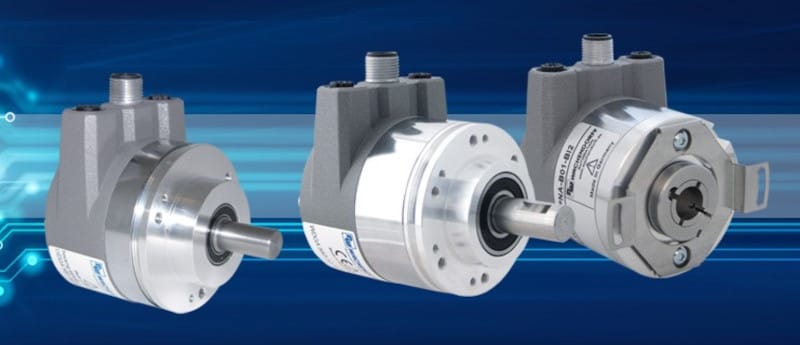
In the world of industrial automation, a Programmable Logic Controller (PLC) is the brain — making thousands of decisions per second. But even the smartest brain is useless without accurate “senses.” That’s where encoders come in.
From high‑speed packaging lines to precision CNC machines, encoders provide the critical feedback a PLC needs to understand position, speed, and direction. If you want to eliminate drift and achieve 99.9% accuracy, mastering the PLC‑Encoder loop is non‑negotiable.
Core Types of Encoders
Incremental Encoders
- Generate pulses that indicate relative movement.
- Output lines: A phase, B phase (direction), and Z phase (index pulse).
- Cost‑effective and widely used for speed control.
Absolute Encoders
- Provide a unique position value for every rotation point.
- Retain position even after power loss — no homing required.
- Ideal for safety‑critical or heavy machinery applications.
Rotary vs. Linear
- Rotary encoders measure shaft rotation.
- Linear encoders measure straight‑line movement.
Integration with PLC Systems
- Wiring: Encoder signal lines (A, B, Z) connect to PLC high‑speed inputs.
- High‑Speed Counters (HSC): Specialized PLC functions (e.g., Siemens SFB47) process fast pulse streams.
- Direction Logic: PLC interprets A/B phase relationship (quadrature) to determine clockwise vs. counter‑clockwise rotation.
Why the PLC Needs an Encoder
Without encoders, PLCs operate in open‑loop control — telling motors to spin without knowing if they actually moved. Adding encoders creates a closed‑loop system with benefits like:
- Position Verification: Robotic arms stop at the exact millimeter.
- Speed Synchronization: Conveyor belts run in perfect sync.
- Stall Detection: PLC shuts down if power is applied but no movement is detected.
Choosing the Right Tool: Incremental vs. Absolute
| Feature | Incremental Encoder | Absolute Encoder |
|---|---|---|
| How it works | Generates pulses | Provides unique digital code |
| Power Loss | Loses position, needs homing | Retains position |
| PLC Wiring | Simple (HSC inputs) | Complex (SSI, Profinet, EtherCAT) |
| Cost | Budget‑friendly | Premium |
Use Incremental for simple speed control.
Use Absolute for safety‑critical or heavy machinery where homing is impractical.
The Technical Bridge: High‑Speed Counters (HSC)
Standard PLC inputs often miss encoder pulses at high RPMs. For example, a 3000 RPM encoder with 1024 pulses/rev overwhelms standard inputs.
Solution: High‑Speed Counter modules capture pulses independently of the PLC scan cycle, ensuring accurate data.
Common Troubleshooting “Gotchas”
- Electrical Noise (EMI): Use shielded twisted‑pair cables to avoid ghost pulses.
- Mechanical Misalignment: Ensure proper shaft coupling to prevent jitter.
- Z‑Pulse Issues: Verify index pulse wiring for accurate homing.
Building for Industry 4.0
Encoders are evolving beyond simple wiring. With smart protocols like IO‑Link and Profinet, PLCs can now monitor encoder health, predict failures, and enable predictive maintenance.
Quasar Mechatronics: Your Automation Partner
At Quasar Mechatronics, we specialize in integrating encoders with PLC systems for maximum precision and efficiency. Our solutions include:
- Encoder selection and installation
- PLC programming and HSC configuration
- Troubleshooting and EMI mitigation
- Smart upgrades for Industry 4.0 readiness
📞 Contact us: +91 95853 24571
📧 Email: sales@quasarmechatronics.com
🌐 Visit: www.quasarmechatronics.com
💼 LinkedIn: www.linkedin.com/in/quasar-mechatronics (linkedin.com in Bing)