
Why Every Coir Factory Needs Light Curtain Sensors ?
Introduction: The “Golden Fiber” Paradox
The coir industry is the backbone of sustainable agriculture, turning humble coconut husks into globally exported “golden fiber” and nutrient-rich pith blocks. But inside the factory, the reality is heavy, industrial work. From the deafening roar of defibering drums to the immense pressure of hydraulic baling presses, the machinery used to compress 5kg blocks and grow bags is powerful and unforgiving.
For years, safety meant metal cages and heavy sliding gates. While safe, they are slow. In an industry where margins are tight and volume is king, every second spent opening and closing a safety gate eats into your profits.
This brings us to a critical upgrade that modern coir mills are adopting: Safety Light Curtains. This isn’t just a fancy add-on; it is a necessity for any mill aiming for high efficiency and zero accidents. Here is why your factory needs to make the switch.
1. Uncompromising Safety for Hydraulic Presses
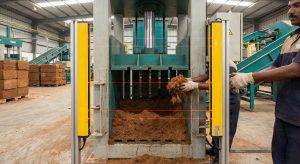
The most dangerous machine in a coir plant is the vertical hydraulic baling press. Operators are constantly reaching into the “danger zone” to load loose pith, place bags, or remove compressed blocks.
A moment of distraction or a miscommunication can lead to severe crushing injuries or amputations. Light curtains create an invisible wall of infrared beams across the machine’s opening.
The Instant Stop: If an operator’s hand breaks a beam while the ram is coming down, the machine stops instantly (in milliseconds).
No Human Error: Unlike a button that relies on the operator checking if the coast is clear, the light curtain knows if the coast is clear.
2. Speed is Money: Reducing Cycle Time
In the production of 5kg blocks or 650g briquettes, speed is everything.
The Old Way (Physical Gates): The operator loads the pith → closes the gate → presses start → waits → opens the gate → unloads.
The New Way (Light Curtains): The operator loads the pith → presses start.
Because there is no physical barrier to move, you eliminate the “gate time.” Saving just 5 to 8 seconds per block might seem small, but over an 8-hour shift, this can result in dozens of extra blocks produced without any additional labor cost.
3. Compliance and Global Export Standards
If you are exporting to Europe, the US, or Australia, your buyers care about more than just the quality of your peat. They care about ethical manufacturing. International buyers frequently audit suppliers for safety standards. Having modern safety systems like Type-4 Light Curtains installed demonstrates that your facility meets global ISO safety standards. It signals to your buyers that you value worker welfare, making you a lower-risk partner for long-term contracts.
4. Beating the “Dust” Myth
A common hesitation in the coir industry is: “Will it work with all this dust?” Coir pith dust is fine and pervasive. In the past, older sensors would get covered in dust and stop working. However, modern industrial light curtains come with IP65/IP67 ratings and adjustable sensitivity. They are built to see through minor dust and withstand the harsh environment of a fiber mill, provided they are wiped down during standard shift maintenance.
Conclusion: An Investment, Not an Expense
It is easy to look at the price tag of a safety light curtain and compare it to a simple metal gate. But this is a false comparison. A metal gate protects your workers but throttles your speed. A light curtain protects your workers and unleashes your machine’s full potential.
When you factor in the increased daily production, the elimination of injury lawsuits, and the compliance with export norms, the Return on Investment (ROI) is undeniable.
