
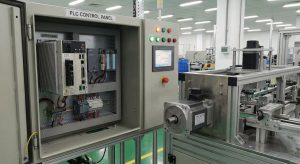
In the world of industrial automation, “good enough” rarely cuts it. When you need exact positioning, high speeds, and consistent torque, standard induction motors often fall short. Enter the dynamic duo of automation: the Servo Motor and the Servo Drive.
But having a servo system is only half the battle; the real magic happens when you integrate it with a Programmable Logic Controller (PLC). This guide breaks down what these components are and how to orchestrate them using a PLC panel.
1. The Basics: What is a Servo System?
A servo system is a closed-loop mechanism that uses feedback to control motion with extreme precision. It consists of two main parts:
The Servo Motor
Unlike a standard motor that spins freely when powered, a servo motor is designed for precise stops, starts, and varying speeds. It contains a built-in encoder (sensor) that constantly reports the motor’s exact angle, speed, and position.
The Servo Drive (The Amplifier)
Think of the drive as the “brain” of the motor. It receives command signals from the PLC and translates them into the high-power voltage and current the motor needs to move. Crucially, it reads the feedback from the motor’s encoder to correct errors instantly. If the motor is 0.1mm off target, the drive adjusts the power to fix it.
2. Why Choose Servos over Steppers or Induction Motors?
Closed-Loop Feedback: It never “loses steps” like a stepper motor might under heavy load.
High Torque at High Speeds: They maintain strength even when moving fast.
Dynamic Response: They can accelerate and decelerate almost instantly, which is vital for packaging and cutting machines.
3. The Core: Controlling a Servo with a PLC Panel
The PLC is the “Conductor” of the orchestra, telling the Servo Drive what to do and when to do it. There are three primary ways to link a PLC to a Servo Drive:
Method A: Pulse & Direction (The Classic Method)
This is common for simple positioning tasks.
How it works: The PLC sends a stream of high-speed pulses to the drive.
Frequency of pulses = Speed of the motor.
Number of pulses = Distance (Position).
Hardware Required: A PLC with Transistor Outputs (High-Speed Output/HSO) is mandatory. Relay PLCs cannot switch fast enough.
Method B: Analog Control
How it works: The PLC sends a voltage signal (usually 0-10V or -10V to +10V) to control speed or torque.
Best for: Applications needing precise speed control rather than position, or simple tension control systems.
Method C: Fieldbus / Communication (The Modern Standard)
In advanced Industry 4.0 panels, we use communication protocols like EtherCAT, Profinet, Modbus, or CANopen.
How it works: The PLC sends digital data packets. “Move to Position X at Speed Y.”
Advantages: drastically reduced wiring (just one Ethernet cable), better diagnostics, and real-time feedback monitoring directly on your HMI.
4. Step-by-Step Integration Guide
If you are building a PLC panel to control a servo, here is your workflow:
Sizing: Ensure the Servo Motor torque curves match the inertia of the load you are moving.
Wiring:
Connect the Encoder Cable between the Motor and the Drive (Feedback loop).
Connect the Power Cable from the Drive to the Motor.
Connect the Control wiring (I/O) from the PLC to the Drive (CN1 connector usually).
Parameter Setting (Tuning): Before programming the PLC, you must “tune” the drive. This involves setting the electronic gear ratio and inertia ratio so the drive understands the mechanical load.
PLC Programming:
For Pulse control, use motion instructions like PLSY (Pulse Y-output), DRVI (Drive Increment), or DRVA (Drive Absolute).
Typically, you will program a “Homing” routine first so the machine knows where its “Zero” position is.
Conclusion:
The Servo Motor provides the muscle, the Drive provides the regulation, and the PLC provides the logic. Mastering the communication between these three allows you to build machines that are faster, safer, and infinitely more precise.
📞 Contact us for a quote: +91 95853 24571
📧 Email: sales@quasarmechatronics.com
🌐 Visit: www.quasarmechatronics.com
💼 www.linkedin.com/in/quasar-mechatronics